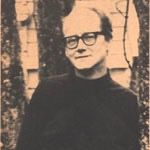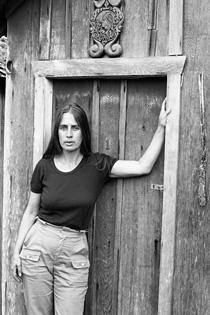
Robert Duncan (1919-1988) was born in Oakland, California, and passed away in San Francisco, California. In fact, he spent the majority of his life in California—with some important exceptions during a stint in New York City, integrating into the downtown coterie surrounding Anaïs Nin, and later teaching at Black Mountain College—and played a foundational role in the poetry movement now known as the San Francisco Renaissance, promoting a local poetics. Duncan’s poetry was informed by the occult upbringing he received from his adopted parents. It is also collage-like, often serial in form, and deeply engaged with processual structures of language itself. His 1973 collection The Opening of the Field offers a clear nod in the direction of Charles Olson, a major influence and the subject of his 1961 lecture hosted at Ellen and Warren Tallmans’ basement in Vancouver. Duncan lived openly as a gay man and his landmark essay, “The Homosexual in Society,” preceded by a decade any organized queer rights movement in the U.S.
Category: Author
Earle Birney
Earle Birney (1904-1995) was born in Calgary, Alberta, and passed away in Toronto, Ontario. He published over twenty books of poetry that vary greatly in form, content, and method, but that cohere along the lines of experiment, play, and a deep love of language. His writing won him a variety of prizes, notably the Governor General’s Award for poetry, both for David and Other Poems (1942) and for Now Is Time (1945), and the Stephen Leacock Medal for his darkly comic novel about the Second World War, Turvey (1950). Birney’s literary output extends across genres, including poetry, fiction, and playwriting, and his community outreach includes editorial work, as well as the founding and directing of the first Canadian creative writing program at the University of British Columbia. Birney’s impact on Canadian literature can be summarized, in George Bowering’s words: Birney was “the Dean of Canadian Poetry, […] the Federal Minister of Poetry” (Bowering at Birney Reading 23 February 1968, Sir George Williams Poetry Series, 00:00:23).
Lionel Kearns
Lionel Kearns (1937-) was born in Nelson, British Columbia. His studied with Earle Birney and was friendly with the likes of George Bowering, Frank Davey, and Fred Wah, also contributing to TISH. Since his first publication in 1959, Kearns steadily released collections of poetry, fiction, and essays, and is especially known for his forays into digital poetics, including experiments with technological, media-based, and interdisciplinary methods. Although he later abandoned the term, his early, avant-garde work was composed according to an original practice called “stacked verse”—this notational system centers the most heavily stressed syllable of each line, creating a vertical spine down the page; the effect is to emphasize the musicality and breath of the work. Kearns taught in the English Department at Simon Fraser University for over twenty years and became the first Writer-In-Electronic Residence, helping to establish an impactful online creative writing school for children.
Stan Persky
Stan Persky (1941-) was born in Chicago, Illinois, later relocating and obtaining Canadian citizenship. As a teenager, Persky sent early writing to Jack Kerouac who responded with encouragement, welcoming him into the Beat scene, including pivotal literary figures such as Allen Ginsberg and Lawrence Ferlinghetti. When Persky moved to British Columbia, he took some of the Beat generation’s literary concerns with him. He also later co-wrote a book about Robin Blaser with Brian Fawcett, Robin Blaser (2010), that draws on his own anecdotal experience of the time. In the 1960s, Persky co-founded a leftist publication called the Georgia Straight Writing Supplement that later became New Star Books. He worked both as a media commentator for the CBC, and as a professor of political science and philosophy at Capilano University. Persky is the author of twenty odd books that span research on the history of British Columbia, international politics, and made significant contributions to queer activism in Vancouver.
Ellen Tallman
Ellen Tallman (née King; 1927-2008) was born in Berkeley, California, and passed away in Vancouver, British Columbia. Together with her then husband, Warren Tallman, Ellen Tallman played a pivotal community-making role in the Vancouver and larger west coast literary scene, hosting writers and students at their home, and helping to generate a creative ethos that led to the organization of the 1963 Vancouver Poetry Conference—the significance of this conference cannot be overstated as it introduced the U.S. and Canadian west coast scenes to one another, and impacted overlapping generations of literary practitioners. In The Globe & Mail’s obituary of 30 August 2008, Noreen Shanahan writes that “[t]he West Coast poetry movement in Canada owes its life to Ellen Tallman.” While Tallman initially worked as a professor of literature at the University of British Columbia, she later shifted careers, retraining and running a private psychotherapy practice for over three decades. She came out as queer, and lived openly as a feminist and lesbian role model.